
If there’s one thing most acolytes of VR can agree on, it’s that the medium is still very much an experiment in motion. While the technology has found its main homes in the Oculus Rift, HTC Vive, and PlayStation VR (PSVR) platforms, the nuts and bolts of VR’s more social aspects are still very much a free-for-all of ideas. Experiences like Rec Room and Altspace are often regarded as the industry’s accessible, if a bit whacky, standard social spaces.
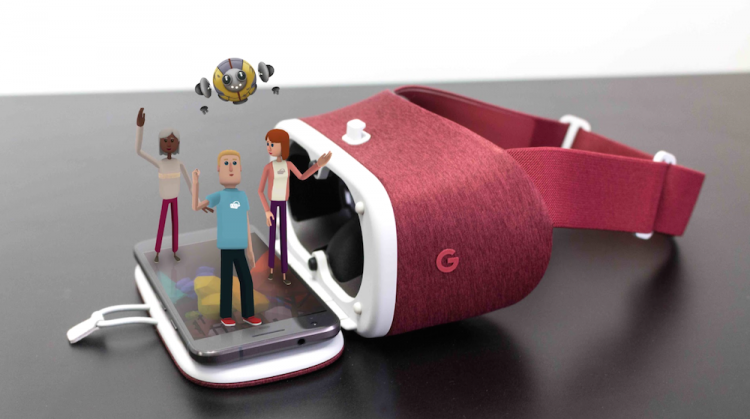
But none of this comes without months or even years of experimentation, something that software engineer Stefan Walker and technical artist Luca Prasso (both of Google) know firsthand. As part of Google’s efforts at Daydream Labs, Walker and Prasso worked on over 110 VR tech prototypes since 2014, all in the name of making a better social experience in virtual reality. The two men showed off their experimental handiwork at a panel during the 2017 Game Developers Conference (GDC) earlier this month.
For both men, the idea of an improved social VR experience hinges on three things: Avatars, “co-presence,” and mixed media, such as the the green screen trailers that companies frequently use to showcase real people in their virtual environments.
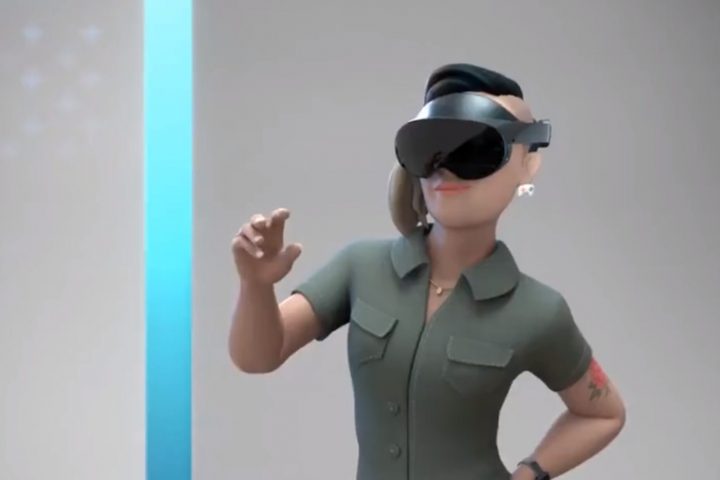
“I’m Italian. I talk with my hands,” said Prasso, referring to the need for well-made representations of our various limbs inside VR. Legs, and by extensions arms, are a unique problem, both for developers and for players. While user comfort was found more highly when their virtual avatar’s hands were distinctly separate from their torso (eliminating the need for upper limbs that could “break” and move unnaturally), user’s found it much more comfortable to see visual representations of their legs (in applicable experiences), if only as aid for not bumping into objects and feeling “grounded.”
While VR users who come from an active gaming background may have grown desensitized to online harassment or general negativity, VR itself is still a wild frontier for users who never anticipated what it meant to actually have another player enter their personal space.
To that end, Prasso and Walker developed a series of incredibly rudimentary VR experiments (with even more rudimentary titles) to test multiplayer scenarios. In “Dance Party,” two players share a small space while music plays.
“People are way less inhibited in VR, so they dance like no one is watching,” Walker said. “But it’s too easy for someone to bump into another person or go under them. Some people would sneak under a person. It feels like an invasion of personal space.”
In “Shopping Together,” Prasso and Walker presented two players with a virtual closet filled with clothing items like hats and glasses. A video Prasso and Walker captured demonstrated how easy it could be to accidentally blind the other player by incorrectly placing a hat or glasses askew on their head. While it might seem minor, a person in VR is unlikely to notice if their partner is being blinded or not.
Walker and Prasso say their backlog of ideas for experimentation is still considerably immense, implying that much more experimentation is still on its way. With experiences like Ubisoft’s “Werewolves Within,” AltSpace, or Rec Room proliferating and staking a claim on the VR market, it may only be a matter of time before the experiments become the standard.
Tagged with: GDC, Google Daydream Labs, social vr
Source: Experiments in Social VR With Developers from Google’s Daydream Labs